Decentralized swaps
Swap from
cold storage.
Trade across chains straight from your KeepKey — through decentralized protocols only, with keys that never leave the device. No accounts. No custody. No middleman that can freeze your funds.
The principle
Decentralized,
or not at all.
Every swap KeepKey offers settles on-chain through non-custodial protocols. We don't route your trade through a centralized middleman — it's the line we don't cross.
Non-custodial
No company or exchange account ever holds your coins. Cross-chain trades settle through decentralized protocol vaults secured by the network's nodes (TSS) — there's no custodian who can freeze your funds, and your signing keys never leave the device.
No account, no KYC
Trade your own money without asking permission. No sign-up, no identity check, no waiting on approval to access funds you already own.
Native settlement
Real assets on real chains. Swap native BTC for native ETH, RUNE, SOL — settled on-chain through the underlying networks. No wrapped IOUs you have to trust.
Why it matters
A swap button can hand
your coins to a custodian.
When a swap routes through a centralized middleman, your coins leave your custody mid-trade. You're trusting a company not to freeze them, trade against your order, widen the spread, or demand your ID — and to return your funds when it's done. KeepKey doesn't take that bet — and won't ask you to.
Custodial swap model
KeepKey · decentralized routing
How it works
Three taps. One signature.
Keys stay home.
The same swap flow that runs inside KeepKey Vault — quote, verify, settle.
Preview the best route
KeepKey compares every decentralized provider at once and shows you the winning quote — rate, route, and fees — before you sign anything.
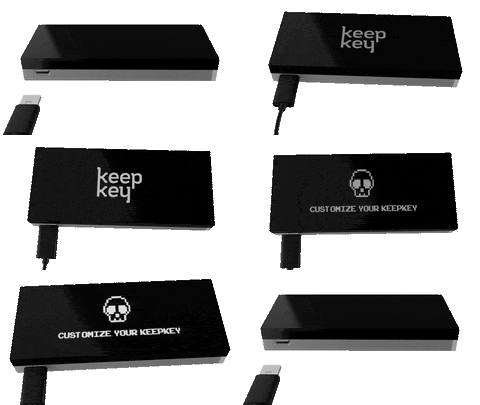
Verify on the device
The trade details appear on your KeepKey's screen. You approve with one press. The signing key never leaves the hardware — not for a swap, not for anything.
Settle on-chain
The protocol executes the swap natively across chains. Watch it move in real time, then it's done — funds land back in your own wallet.
The router
One quote.
Every decentralized route.
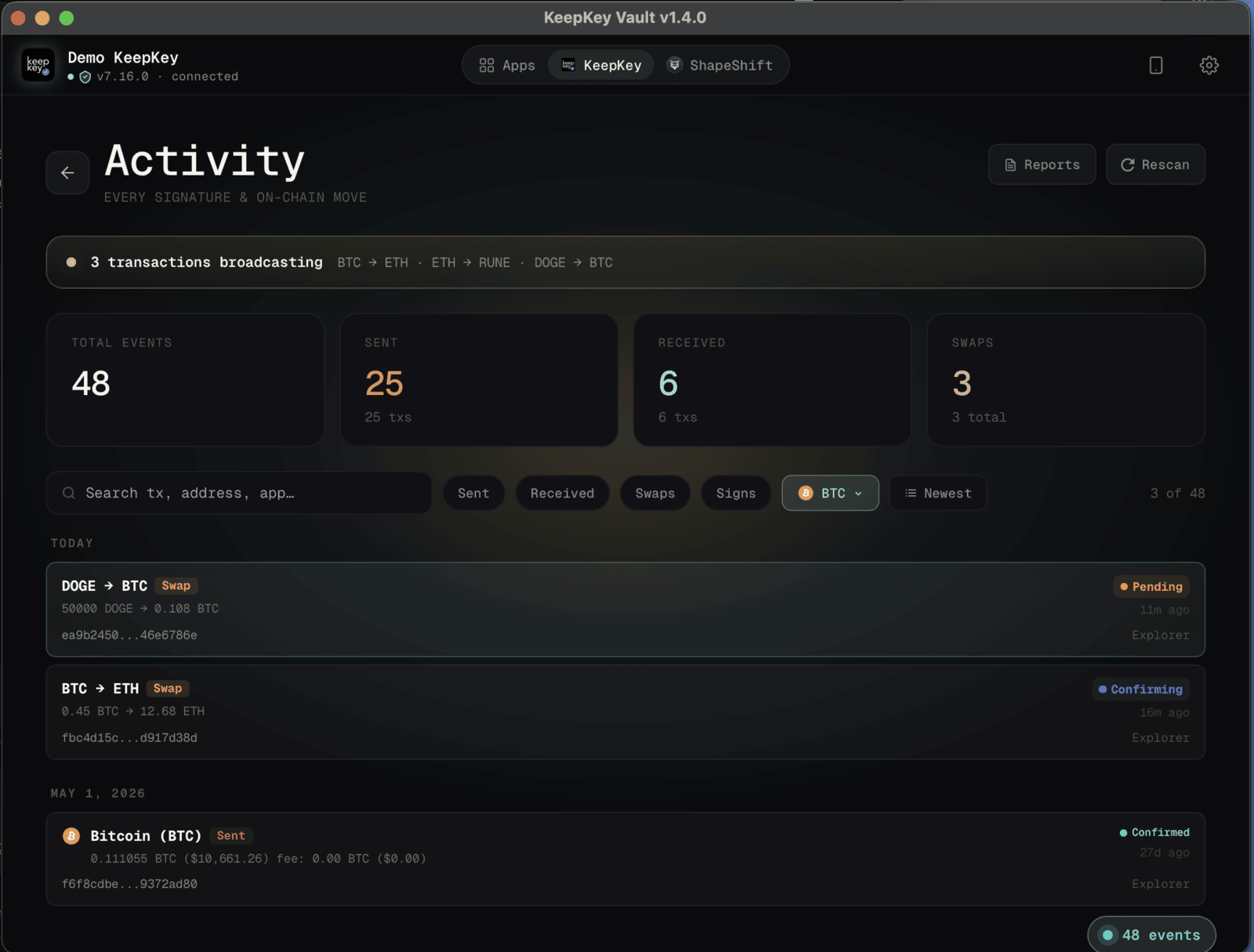
KeepKey's swap engine aggregates the best of decentralized liquidity — cross-chain protocols and DEX aggregators alike — and routes your trade through whichever path wins on price. Every one of them non-custodial.



The tradition
Born from ShapeShift.
ShapeShift set the standard for non-custodial swapping for the better part of a decade. KeepKey joined ShapeShift in 2017 — and we carry that principle forward in every trade.
Our ShapeShift story →Swap from cold storage.
Trade across chains without ever handing over your keys — or your trust.
Does KeepKey ever hold my coins during a swap?
No. KeepKey and its makers never take custody of your coins. Cross-chain swaps do route through a protocol vault address — for example THORChain's inbound vault, secured by its node network via threshold signatures (TSS) — but no company or exchange account holds your funds, and your signing keys never leave the device.
Do I need an account or KYC to swap?
No. There's no sign-up and no identity check. You're trading your own assets from your own wallet — no one's permission required.
Which protocols does the swap engine use?
It aggregates decentralized routes — THORChain, ShapeShift, ChainFlip, Maya, and DEX aggregators like 0x, 1inch, Uniswap, CoW, Curve, LI.FI, Across, Relay, NEAR Intents, Sushi and Balancer — then routes your trade through whichever path wins on price.
How is this different from swapping on an exchange?
A centralized exchange or swap widget takes custody of your coins, can freeze or reverse the trade, and often requires KYC. KeepKey routes only through non-custodial protocols — funds settle on-chain through decentralized vaults that no company can freeze, seize, or reverse.
What happens if a swap doesn't complete?
If a route can't fill, no company is holding your funds — there's no custodial account sitting between you and them. Cross-chain protocols like THORChain and Maya are designed to refund automatically; on-chain DEX swaps simply don't execute if the trade can't complete.